
The AI Maturity Model
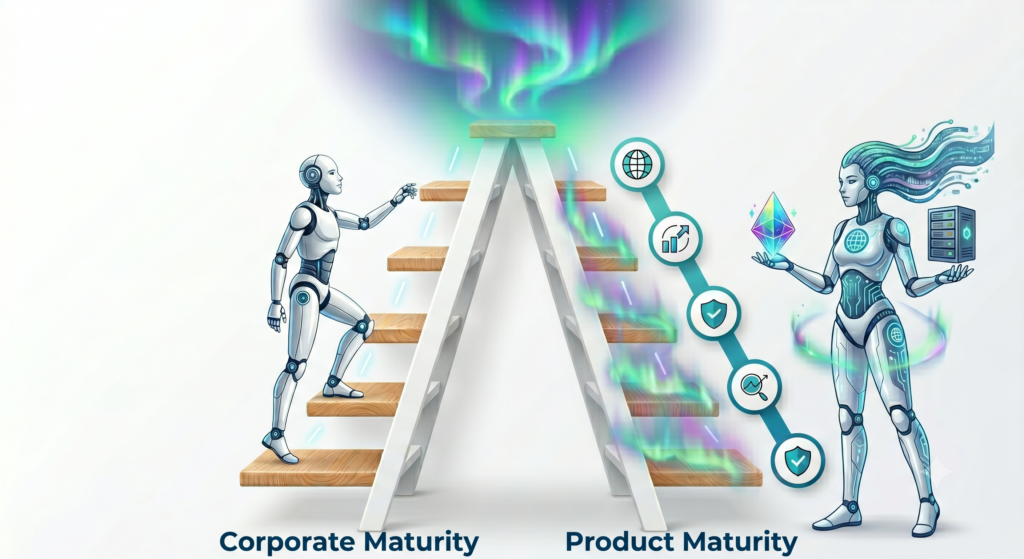
TL;DR: AI maturity models grade how well you adopt AI internally. That is the
wrong axis. What decides survival is whether your product has climbed from selling
tools to selling outcomes, and customers already demand at least Level 3.
Most AI maturity models measure how well a company adopts AI
internally. For a software or SaaS company, that is the wrong axis. The maturity
that decides survival is whether your business model has moved from selling tools
to selling outcomes. A company can be “fully transformed” on the standard AI
maturity models the giants published and still be shipping a doomed seat-based
product.
A caveat that sharpens the point: this is about software. If you run a
food-delivery app or a factory, the standard model is fine. Your product (the meal,
the part) is never going to become an agent, so internal adoption is the right
thing to measure. But if you sell software, your product is exactly what AI is
turning into an agent. For you, internal adoption is no longer the point.
The standard AI maturity model
The common frameworks from the giants (Gartner, Microsoft, Accenture)
run a 5-stage
progression of internal adoption: Ad Hoc, Emerging, Defined, Scaled,
Transformational, assessed across four pillars (Tech & Data, Governance & Security, Org & Culture, Strategy & Value).
These models grade you on consumption: how much AI you have adopted, how well you
govern it. But in the SaaSpocalypse, the customer does not care how mature your
internal adoption is. They care whether you deliver the outcome.
The ladder (5 product levels)
The real maturity curve is about what you sell, not what you use:
- Tool. You sell software, the customer does the work. Per seat. Classic SaaS.
- Assisted tool (copilot). Software plus an AI helper, the human still drives.
Per seat, maybe an AI upsell. Most “AI features” today live here and call it
transformation. - Agent. An agent does the task end to end, a human approves exceptions. You
sell completed work, not access. Pricing shifts to per task / usage. - Outcome. You sell the result, the software goes invisible. The customer says
what they want, the system delivers it. Per outcome. - Autonomous. The outcome runs as a self-managing service the customer consumes
like a utility.
The mix-up of levels
- The confusion: Some organizations mix up the 5 levels of company maturity with
the 5 product levels. Different scales, different questions. - The excuse: Others focus on climbing the company ladder and treat their own
product level as a low priority, because their customers’ org maturity is low. - The mistake: Customers have goals too. Even the less mature ones want to engage
with vendors at a minimum of product Level 3. That pressure is, again, the
SaaSpocalypse.
The point
- Value migrates UP the ladder: from selling access (seats) to selling work done
(outcomes). Each rung, the human does less and the price attaches to results, not
logins. - Most “AI maturity” today is rung 2 dressed up as rung 5. Bolting on a copilot
does not move you up. Changing what you sell and how you price does. - This is the maturity that decides survival in the SaaSpocalypse, not internal
adoption. A company can be Gartner Level 5 internally and still sell a product at rung 1 (or most likely at rung 2 nowadays).