Software Is No Longer the Moat
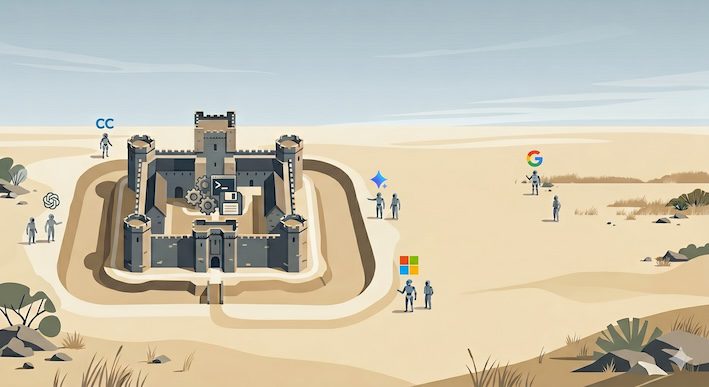
TL;DR: AI made software buildable by almost anyone, so the software itself is no longer a moat. The advantage moves to distribution, trust, and domain access, which favors small, fast operators who own a market over anyone who can simply build.
We crossed a line with this generation of AI. Software is now buildable by almost anyone, and when building is cheap and fast, the software itself stops being defensible. The thing companies guarded for decades, “we built the product,” no longer protects them. Call it the SaaSpocalypse: when building is free, the thing you sold stops being scarce.
The two-to-four-year clock
Traditional vendors that don’t become agentic outcome companies, selling the result instead of the tool, have two to four years. AI is becoming both the tool and the brain: it delivers the outcome, not just the interface.
It won’t stop at screens, either. As AI gets physical bodies, labour-dependent businesses that skip humanoid robotics follow the software vendors down the same path.
This is also an enormous opening. The same force that erases the incumbents’ advantage hands leverage to a small, fast operator. One person with AI can now do what used to take a funded company.
The moat didn’t vanish, it moved
Here is the catch. The thesis cuts both ways. If you can build anything in a weekend, so can everyone. So the moat doesn’t disappear, it moves to three places:
- Distribution. Who actually reaches the customer.
- Trust and brand. Who they choose when every option works.
- Domain access. The relationships and credibility inside a niche worth serving.
So the question is no longer “can you build it.” Everyone can. It is whether a given market already trusts you to deliver the outcome. Three moves:
- Pick a market you already have access to.
- Sell the result, not the tool.
- Build trust before you build features.
That is where the next decade of value goes.